LuitBiz QMS is an integrated Quality Management System designed to help US organizations manage quality documentation, control operational processes, investigate quality issues, and maintain accountability across departments and locations.
From controlled SOPs and document revisions to deviations, nonconformances, root cause investigations, Corrective and Preventive Actions (CAPA), and change management, LuitBiz QMS brings essential quality management activities together in one structured platform.
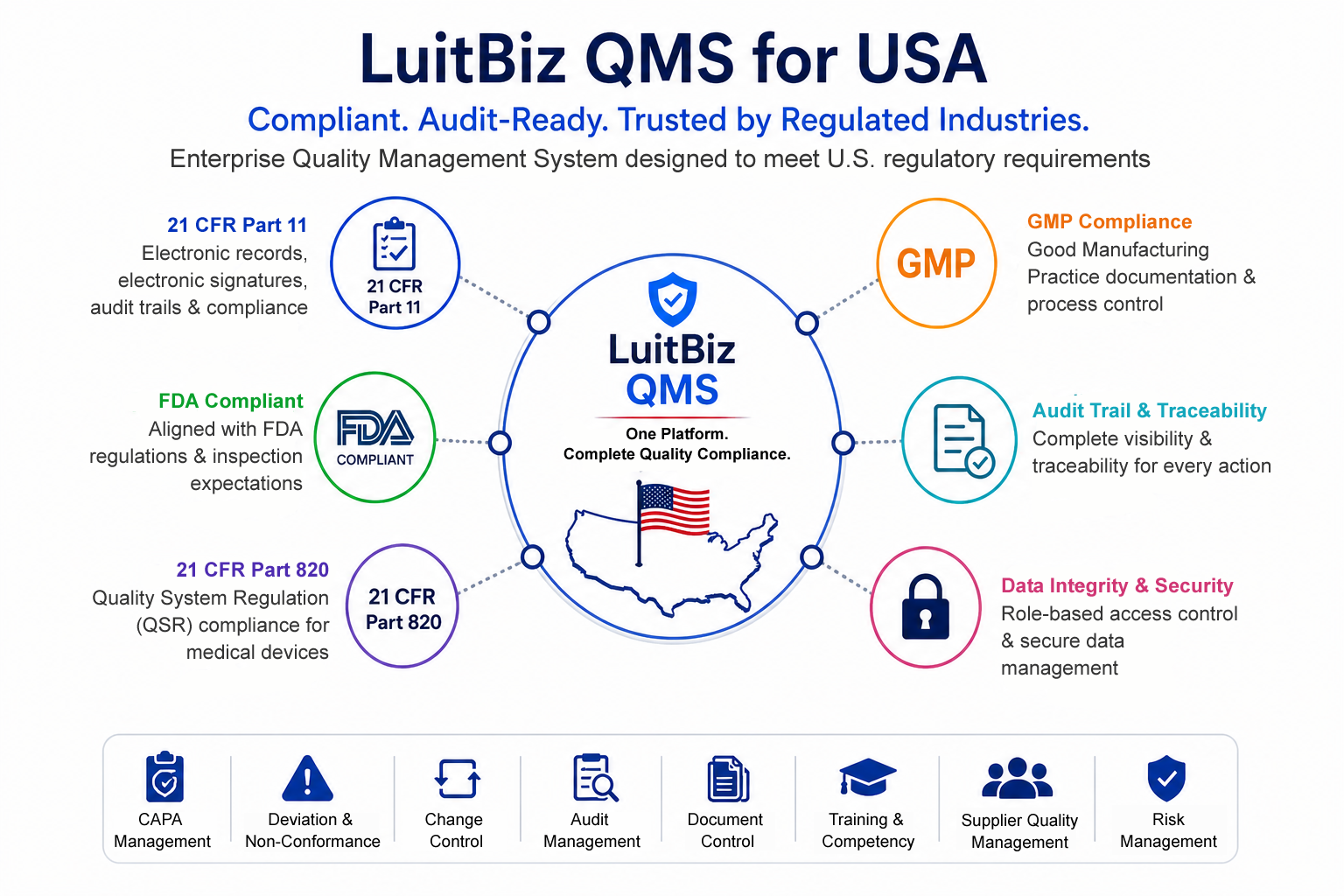
Designed for pharmaceutical companies, life sciences organizations, medical device manufacturers, industrial manufacturers, and other quality-driven businesses, LuitBiz helps replace disconnected spreadsheets, email approvals, and manual follow-ups with configurable workflows and traceable quality records.
All customer data, backups, and system infrastructure are securely hosted in U.S.-based cloud data centers. While our engineering / support teams are based out of Bangalore (India), their access to production data is governed by strict, encrypted role-based access control (RBAC) and logs, ensuring no unauthorized data exfiltration occurs out of the U.S. environment.
With LuitBiz QMS, your organization can:
Bring your quality management processes together with LuitBiz QMS.
A Quality Management System (QMS) is a structured framework of policies, procedures, responsibilities, and processes that an organization uses to maintain consistent product and service quality, meet customer requirements, and fulfill applicable regulatory and industry obligations.
A digital Quality Management System helps organizations manage these activities through centralized documentation, defined workflows, approval processes, and traceable records.
Typical QMS activities include:
An effective QMS is not simply a document repository. It connects quality documentation with the processes used to identify problems, investigate their causes, implement corrective actions, and prevent recurrence.
LuitBiz QMS brings Document Control and Process Control together to support a more organized approach to quality management.
Organizations operating in the United States face quality requirements from customers, industry standards, and regulatory authorities. Maintaining consistent procedures and reliable quality records becomes increasingly challenging as operations expand across departments, facilities, and locations.
Common challenges include:
1. Uncontrolled Quality Documents
Employees may refer to outdated SOPs, work instructions, specifications, or policies when documents are stored in separate folders or circulated through email.
A controlled document management process helps ensure that employees can access the appropriate approved versions and that document revisions and approvals remain traceable.
2. Incomplete CAPA Investigations
Identifying a quality problem is only the beginning. Organizations need to investigate the root cause, define containment and corrective actions, assign responsibilities, monitor implementation, and determine whether the actions were effective.
A structured CAPA workflow helps quality teams manage the process from identification through closure.
3. Disconnected Deviations and Nonconformances
When deviations, nonconformances, complaints, and incidents are maintained in separate spreadsheets or forms, maintaining a complete investigation history becomes difficult.
A centralized process management system helps organize these records and their associated actions.
4. Difficult Audit and Inspection Preparation
Quality teams need to retrieve relevant documents, approvals, investigation records, and corrective action information when preparing for internal audits, customer audits, and regulatory inspections.
Organized records and traceable workflows can make it easier to locate and review the required information.
5. Uncontrolled Changes
Changes to procedures, products, equipment, specifications, and operational processes may require documented review, impact assessment, approval, and implementation tracking.
A structured change control process helps ensure that changes are reviewed and recorded appropriately.
6. Limited Visibility Across Departments
Without centralized records and assigned responsibilities, managers may struggle to identify overdue actions, recurring quality issues, and unresolved investigations.
Digital QMS workflows can improve visibility into the status and ownership of quality activities.
LuitBiz QMS helps organizations move away from fragmented quality management practices towards structured document governance and process control.
US organizations should evaluate QMS software against the regulations and standards applicable to their products, operations, and intended use of electronic records.
LuitBiz QMS provides document control and process management capabilities that organizations can evaluate as part of their quality management systems.
The FDA Quality Management System Regulation (QMSR) became effective on February 2, 2026. It incorporates ISO 13485:2016 by reference and applies to finished medical-device manufacturers within its scope.
Relevant quality management activities include controlled documentation, quality records, management review, audit activities, supplier-related records, and the management of quality issues.
LuitBiz QMS provides document and process management capabilities that can help organizations structure these activities. Medical-device manufacturers should evaluate the system against their specific QMSR obligations and implementation requirements.
Organizations using electronic records and electronic signatures in FDA-regulated activities may need to evaluate applicable requirements under 21 CFR Part 11.
Relevant considerations include:
LuitBiz QMS provides document and workflow controls that organizations can assess against their electronic-record and signature requirements. Part 11 suitability must be established through an assessment of the actual system configuration, procedures, validation, and intended use.
ISO 9001 provides a framework for establishing and maintaining a quality management system focused on consistent processes, customer satisfaction, performance evaluation, and continual improvement.
LuitBiz QMS helps manage controlled documents, nonconformances, corrective actions, change processes, and related quality records that can support an organization's ISO 9001 activities.
ISO 13485 specifies quality management system requirements for organizations involved in medical devices and related services.
For US medical-device manufacturers, ISO 13485:2016 is particularly relevant because it is incorporated by reference into the FDA QMSR.
Organizations should evaluate document control, quality records, nonconformance handling, corrective action, and change management capabilities against their applicable requirements.
Pharmaceutical and other applicable manufacturing organizations need documented procedures, controlled records, appropriate investigations, and systematic corrective action processes.
LuitBiz QMS helps organize SOPs, document revisions, deviations, investigations, CAPA, and change-related records.
Important: QMS software supports an organization's quality management activities; purchasing or implementing software does not itself establish regulatory compliance, provide certification, or guarantee successful inspections.
LuitBiz QMS brings together Document Control and Process Control to help organizations manage quality documentation and related operational processes.
Manage quality documents, SOPs, work instructions, policies, and other controlled information.
Key capabilities include:
Record and manage deviations from established procedures, specifications, or expected processes.
Manage identified nonconformities arising from internal processes, products, customer feedback, or other quality-related activities.
Manage Corrective and Preventive Actions through a structured process rather than disconnected forms and email reminders.
A CAPA process can include:
Manage changes through documented review and approval processes.
Capture and manage quality-related complaints and incidents through structured records and follow-up processes.
Organize quality audits and maintain visibility into audit activities and their outcomes.
Depending on the configured audit workflow, organizations can manage:
Organizations should also evaluate how their QMS manages quality-related risks and employee training requirements. LuitBiz provides document-related training requirements and configurable process capabilities that can be assessed against the organization's specific needs.
One Integrated Quality Management System
Instead of maintaining disconnected records for different quality activities, LuitBiz QMS helps bring document control and process control together.
Quality-related events can be managed through structured workflows, with assigned responsibilities, action deadlines, approvals, and traceable records.
Different industries have different quality management requirements. LuitBiz QMS provides configurable document and process management capabilities that can help organizations establish consistent quality practices.
Pharmaceutical and biotechnology organizations need controlled procedures, reliable documentation, documented investigations, and appropriate corrective action processes.
LuitBiz QMS can help organize:
Medical-device manufacturers must evaluate their quality systems against applicable FDA requirements, including the QMSR.
LuitBiz QMS can support the management of controlled documentation, non conformance records, corrective actions, change processes, and related quality records.
Manufacturing businesses need consistent procedures across production operations, departments, and facilities.
LuitBiz QMS helps manage production-related deviations, non conformance records, corrective actions, process changes, and controlled quality documentation.
Organizations operating in quality-sensitive life sciences environments need structured documentation, documented processes, and reliable records.
LuitBiz QMS can help organize quality documents, investigation records, process approvals, and corrective action activities.
Automotive suppliers and engineering organizations need consistent quality procedures and systematic management of quality issues.
LuitBiz QMS can help with document control, process deviations, non conformance investigations, corrective action tracking, and change control.
Organizations in food processing, chemicals, electronics, infrastructure, and other industries can also benefit from structured document and process management.
Selecting a Quality Management System is a long-term business decision. The software should support the organization's quality processes, operational requirements, employees, and future growth.
Manage controlled quality documents alongside deviations, CAPA, change requests, and other quality-related processes.
Replace disconnected email conversations and spreadsheets with organized records, assigned responsibilities, approvals, and action tracking.
Support the journey from problem identification and root cause analysis to corrective action implementation and closure.
Adapt quality-related forms and workflows to your organization's procedures and operational requirements.
Maintain controlled document versions, approvals, and access permissions to help ensure employees work with authorized information.
Choose a deployment approach based on your organization's infrastructure, security policies, and operational requirements.
LuitBiz is developed by Luit Infotech (P) Ltd., an established business software provider with over two decades of business software experience.
LuitBiz QMS is part of a wider enterprise software suite that includes Document Management (DMS), Business Process Management (BPM), Enterprise Asset Management (EAM), Customer Relationship Management (CRM), and Human Resource Management (HRM & ESS).
Organizations can explore additional modules as their business requirements evolve.
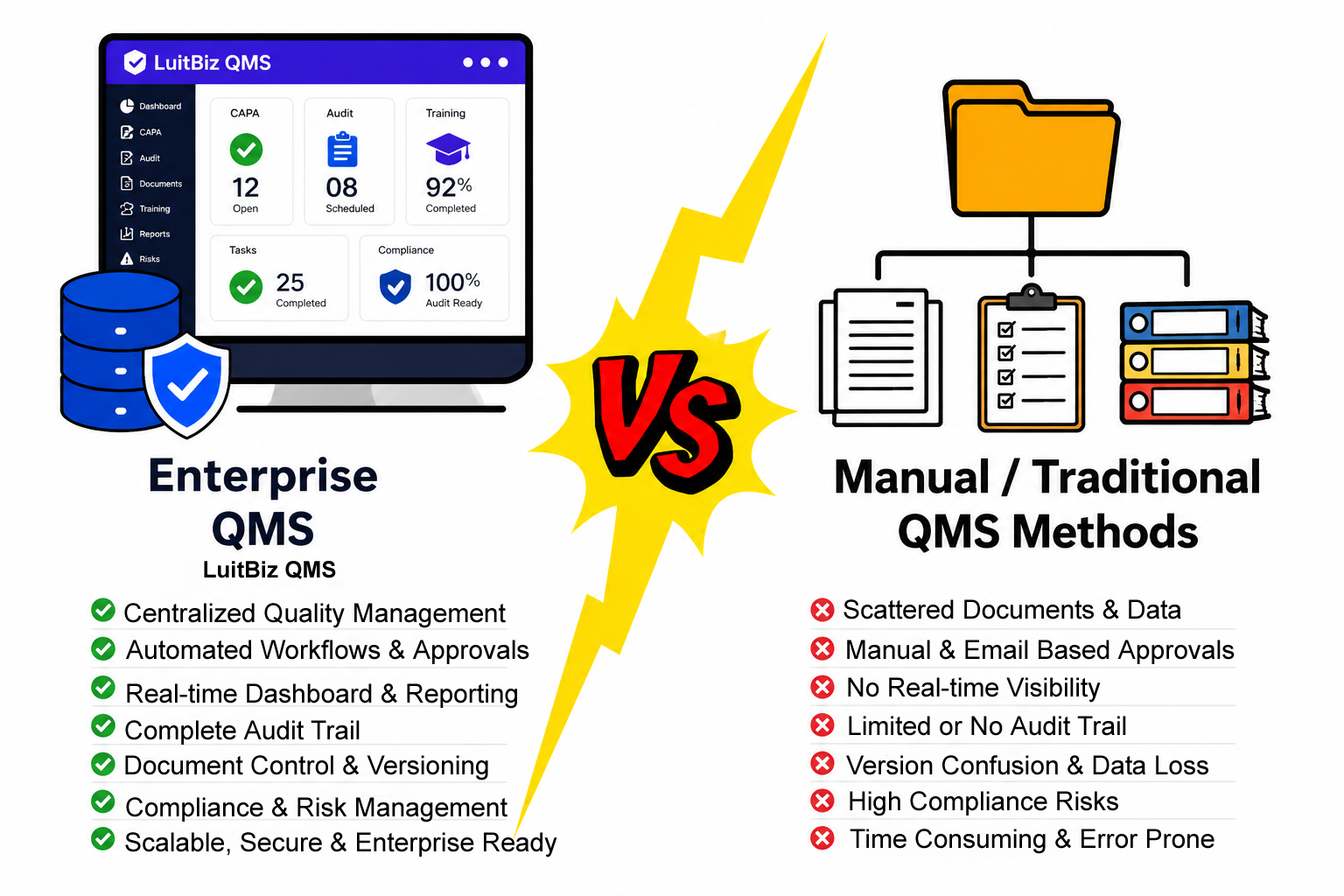
Many organizations begin managing quality through spreadsheets, shared folders, paper documents, and email approvals. These methods can become difficult to maintain as the number of quality records and organizational responsibilities grows.
The objective is not simply to digitize paperwork. It is to establish a more consistent and accountable approach to managing quality throughout the organization.
| Quality Management Activity | Manual or Disconnected Systems | LuitBiz QMS |
|---|---|---|
| SOP management | Documents stored in separate folders | Centralized document control |
| Document revisions | Manual version identification | Controlled revisions and version history |
| Document approvals | Email-based approvals | Structured approval workflows |
| Deviation management | Separate spreadsheets and forms | Centralized deviation records |
| Non conformance | Manual recording and follow-up | Structured non conformance workflows |
| CAPA | Spreadsheet-based action tracking | Organized CAPA workflows |
| Root cause analysis | Separate investigation documents | Documented investigation and 5 Whys |
| Change control | Email-based change requests | Structured change management |
| Action tracking | Manual reminders | Assigned responsibilities and target dates |
| Quality records | Scattered departmental records | Centralized, traceable records |
A well-implemented Quality Management System can improve how an organization manages documentation, handles quality issues, and monitors process performance.
With LuitBiz QMS, organizations can work towards:
Improved Document Control
Maintain controlled versions of SOPs, policies, work instructions, and other quality documents.
More Effective CAPA Management
Manage corrective and preventive actions through structured investigation, root cause analysis, action assignments, and closure processes.
Better Visibility into Quality Issues
Centralize deviations, nonconformances, complaints, and other quality-related records so responsible teams can monitor their progress.
More Organized Audit Preparation
Maintain quality documents, investigation records, approvals, and corrective action information in an organized environment.
Greater Accountability
Assign responsibilities, target dates, and approval requirements to quality-related activities.
Consistent Quality Processes
Establish common document control and process management practices across departments and locations.
Reduced Dependence on Manual Follow-Ups
Use structured workflows to manage submissions, reviews, approvals, and action tracking rather than relying entirely on email and spreadsheets.
Actual business impact depends on the organization's processes, implementation, adoption, and system configuration.
Implementing QMS software requires more than installing an application. The system must reflect the organization's quality procedures, responsibilities, documentation requirements, and approval processes.
A structured implementation approach can help organizations get more value from their QMS investment.
Step 1: Understand Your Quality Management Requirements
Identify existing quality processes, applicable standards, documentation requirements, and operational challenges.
Step 2: Map Your Existing Workflows
Review how your organization currently manages documents, deviations, nonconformances, CAPA, change requests, and other quality activities.
Step 3: Configure Documents, Forms and Workflows
Set up document categories, approval processes, forms, responsibilities, and configurations according to your organization's requirements.
Step 4: Establish Roles and Access Permissions
Define the responsibilities of quality managers, department heads, document controllers, process owners, and other users.
Step 5: Prepare and Migrate Quality Records
Identify existing documents and records that need to be organized or migrated into the new system.
Step 6: Train Employees
Help employees understand how to access controlled documents, submit quality records, complete assigned actions, and follow approval processes.
Step 7: Review and Improve
Monitor system adoption, outstanding activities, and workflow effectiveness. Refine configurations as your organization's requirements evolve.
LuitBiz QMS offers cloud and on-premises deployment options, allowing organizations to evaluate an implementation approach based on their infrastructure and business requirements.
Quality management should not depend on scattered documents, disconnected spreadsheets, and endless email follow-ups.
With LuitBiz QMS, your organization can bring document control and quality processes together in a structured environment.
Whether you are implementing a digital QMS for the first time or looking to improve an existing quality management process, LuitBiz can help you explore a solution aligned with your organization's needs.
See how LuitBiz QMS can help your organization:
LuitBiz has been developing business software since 2004, helping organizations improve governance, efficiency, and operational control.
Request a personalized demonstration and explore how LuitBiz can support your organization's quality management requirements.
Secure. Compliant. Built for growth
The best QMS depends on an organization's industry, regulatory obligations, quality processes, deployment requirements, and budget. Buyers should evaluate document control, CAPA, deviation management, change control, audit management, traceability, configurability, and vendor support. LuitBiz QMS provides integrated document control and process management capabilities for organizations seeking a structured enterprise QMS.
QMS software is used to manage an organization's quality-related documents, procedures, processes, and records. It can help manage controlled documents, deviations, nonconformances, CAPA, change control, audits, and other quality activities through structured workflows.
The FDA Quality Management System Regulation (QMSR) is the FDA's revised medical-device quality-system regulation. It became effective on February 2, 2026, and incorporates ISO 13485:2016 by reference. It applies to finished medical-device manufacturers within its scope.
The FDA does not require organizations to purchase a particular QMS software product. Organizations must meet the regulatory requirements applicable to their products and activities. Appropriate software can help organize documents, quality processes, records, and workflows.
LuitBiz provides document and workflow controls that organizations can evaluate against applicable electronic-record and electronic-signature requirements. Part 11 suitability depends on the system's actual functionality, configuration, validation, procedures, and intended use. Organizations should complete their own compliance assessment.
QMSR establishes FDA quality management system requirements for medical-device manufacturers within its scope and incorporates ISO 13485:2016 by reference. 21 CFR Part 11 addresses electronic records and electronic signatures when applicable. They address different regulatory concerns and should not be treated as interchangeable.
Yes. QMS software can help organizations manage problem identification, containment, root cause investigation, corrective and preventive action planning, implementation, and closure. A well-designed workflow should provide action ownership, target dates, documented evidence, and appropriate review.
Yes. LuitBiz offers cloud and on-premises deployment options. Organizations can discuss their infrastructure, security, and operational requirements when evaluating the appropriate deployment approach.
QMS software should support an organization's specific quality procedures, documentation requirements, forms, and approval workflows. LuitBiz provides configurable document and process management capabilities to support different organizational requirements.
QMS software pricing depends on the number of users, modules, deployment model, customization, implementation, and support requirements. Contact LuitBiz for pricing based on your organization's needs.
Evaluate the software's document control, CAPA, deviation management, non conformance handling, change control, audit capabilities, traceability, security, deployment options, implementation support, and total cost of ownership. Ask vendors to demonstrate workflows using scenarios relevant to your organization.
A QMS can help organizations standardize document governance and quality processes across departments and facilities. Buyers should evaluate location-based access, role permissions, centralized oversight, and the system's ability to support their operational structure.